 ← All posts
A school roof shed plaster on Class 10 students in Chengalpattu. The building was eight years old
New doesn't mean safe. What the response got right, and why a stability certificate should come before an accident rather than after.
What happened
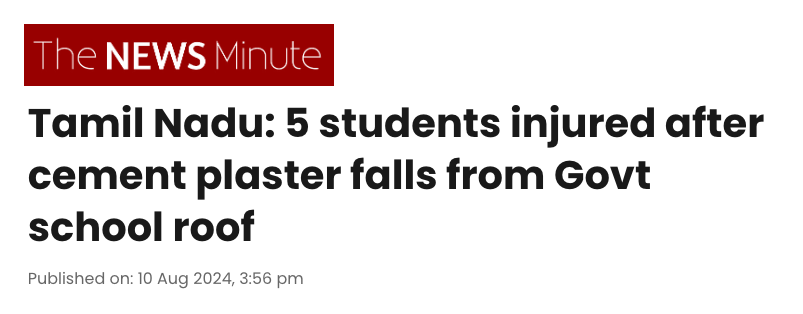
On 8 August 2024, part of the roof of a government school in Tamil Nadu's Chengalpattu district came down during class hours, and cement plaster fell onto students' desks, The News Minute reported. Five Class 10 students were hurt. One reportedly had a serious head injury and four had minor injuries, and all were later discharged.
The building had been completed in 2016. The public works department was told to inspect it. The building would stay empty until a stability certificate was issued, and classes moved to a private building on the same street.
What would have made the difference
The response here was the right one: get children out, inspect, certify and repair. The harder question is why that sequence only started after five students were hurt.
The Supreme Court's 2009 judgment in Avinash Mehrotra v Union of India expects an inspection of a school's facilities before each academic year, and structural evaluation at regular intervals. An eight-year-old building might feel too new to worry about. But the report doesn't say why the plaster failed, and a building's age tells you little about how it was built or whether water has been getting in.
Questions to ask your child's school
- When was the last inspection, and did it cover newer blocks as well as old ones?
- Are there flakes of plaster, damp patches or cracks in my child's classroom?
- Who should a teacher or parent tell if they see these?
- If a block has to close, where do classes go, and how quickly?
What software can and can't do here
We make , and it would not have kept the plaster up. One small thing it does today: teachers can post a class announcement telling parents where classes have moved and why. That's communication after the event, not prevention.
Not in the app today. These can be built for your school on request:
- A register with inspection dates and stability certificate expiry for every block, whatever its age.
- A defect report for flaking plaster or damp, with photos and a clear status.
The details above are as reported by The News Minute on 10 August 2024. We have no independent information. Some points were allegations or early accounts at the time, and later findings may differ. To correct something on this page or ask us to change it, contact us.
School management software and a parent app for schools and colleges across India.
Tell us what your school needs →